Region · Eriador
Rhudaur
The northeastern third of divided Arnor, taken over by hill-men in league with Angmar
- Appears in
- Appendices
- Region
- Eriador
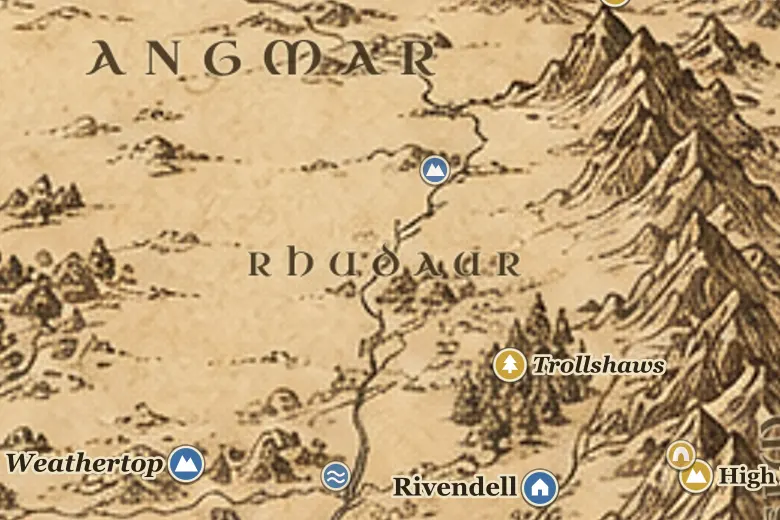
Rhudaur occupied the northeastern quarter of Eriador: the Trollshaws and the Angle between the Hoarwell and the Loudwater, with the Ettenmoors above and the Weather Hills on its western border. Rivendell lies at its eastern edge, which made the region strategically important and chronically contested.
Of the three realms created when Arnor was divided in TA 861, Rhudaur had the fewest Dúnedain. Evil hill-men took control of it, and by TA 1350 a lord of their kind ruled the country in secret alliance with the Witch-king of Angmar. The remaining Dúnedain of Rhudaur were killed or fled west to Arthedain.
After that Rhudaur was Angmar's road into Eriador. Its forces joined the attack of TA 1409 that destroyed Cardolan and burned the tower of Amon Sûl. The Stoors who had settled in the Angle, hobbit-kindred among them the ancestors of Sméagol, abandoned the country around TA 1356 and moved away west and east.
Events at this place
-
TA 1350 · Appendices
Hill-men seize Rhudaur
A lord of the hill-men took the realm, secretly allied with Angmar, and the Dúnedain of Rhudaur were destroyed or driven out.
-
TA 1356 · Appendices
The Stoors leave the Angle
Hobbits of Stoor kind who had settled between the Hoarwell and the Loudwater fled the growing danger, some going west toward Bree.
-
TA 1409 · Appendices
Rhudaur attacks Arthedain and Cardolan
Angmar's assault came through Rhudaur, overran Cardolan and threw down the tower of Amon Sûl.
Frequently asked questions
Where was Rhudaur on the Middle-earth map?
In northeastern Eriador, between the Weather Hills and the Misty Mountains, taking in the Trollshaws and the Angle between the Hoarwell and the Loudwater.
Why did Rhudaur fight against the other Arnorian kingdoms?
It fell under the control of hill-men allied with the Witch-king of Angmar, after its own Dúnedain population was destroyed or driven out.